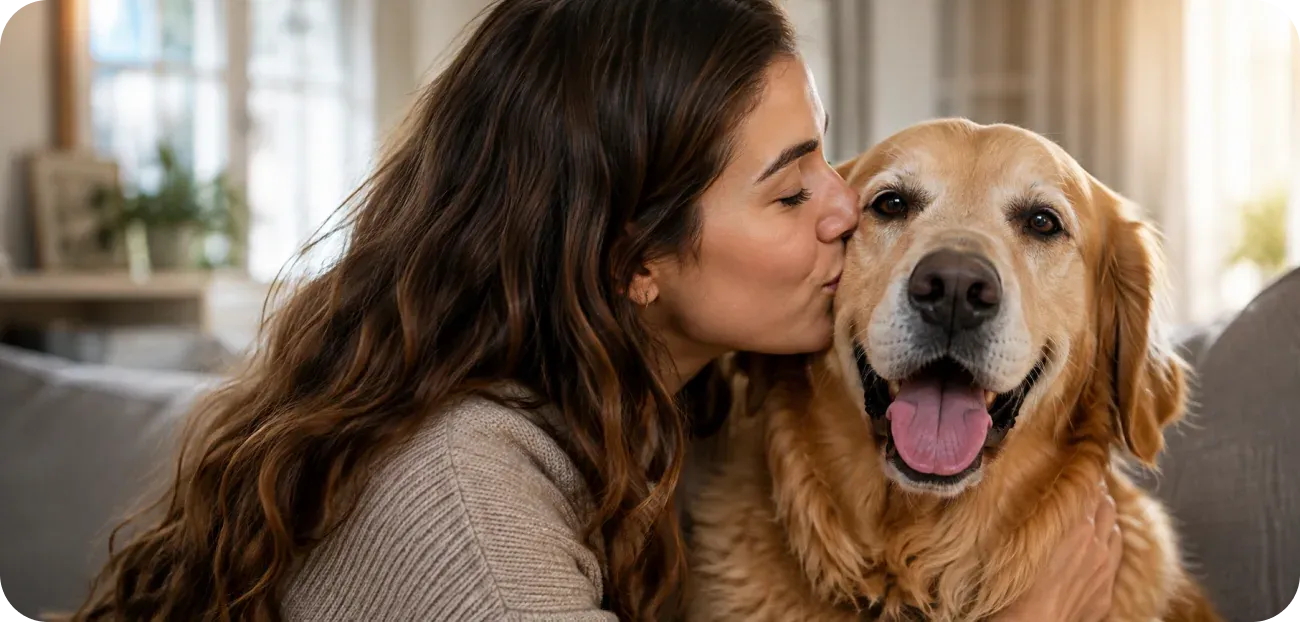
Prioritise useful life skills—responding to their name, recall, toilet habits, comfortable lead walking, settling, handling and gradually spending time independently—before worrying about an impressive list of commands. Current veterinary-behaviour guidance recommends reward-based training rather than aversive methods involving pain, fear or intimidation.
The principle is simple:
Good puppy training is not about controlling a puppy. It is about teaching them how to succeed in the world they share with you.
Training starts with understanding how puppies learn
Puppies are learning constantly, whether or not you have formally decided that it is “training time.”
When sitting calmly results in attention, that behaviour may become more likely. When coming toward you leads to something enjoyable, returning to you becomes worthwhile. If jumping repeatedly produces interaction, even frustrated interaction, the puppy may also learn that jumping works.
This is the foundation of reward-based training: behaviours followed by outcomes the puppy values are more likely to happen again. Veterinary behaviour guidance supports reinforcing desired behaviours rather than relying on aversive correction.
That means training is happening when you put on the lead, open the door, serve dinner, greet the puppy, play together or settle in the evening—not only when you hold a treat and say “sit.”
Start with the behaviour you want
Guardians naturally notice unwanted behaviour.
“Stop biting.”
“Don't jump.”
“Don't pull.”
“Don't steal that.”
The problem is that “don't” does not tell the puppy what to do instead.
A more useful training question is:
What would I like my puppy to do here?
Instead of focusing exclusively on jumping, reinforce keeping four paws on the floor.
Instead of repeatedly correcting pulling, teach the puppy that moving with you on a loose lead allows the walk to continue.
Instead of fighting over a stolen object, teach exchanging and reinforce interaction with appropriate items.
RSPCA Australia uses jumping as a practical example of this principle: reinforce the puppy when their paws are on the ground rather than physically punishing the jumping.
This shift—from stopping behaviour to teaching behaviour—is one of the most useful skills a new guardian can learn.
Use rewards your puppy actually values
A reward is only a reward if the puppy wants it.
Food is extremely useful because it can be delivered quickly and precisely, but it is not the only possibility. Depending on the puppy and situation, useful rewards can include play, access to something interesting, a favourite toy, praise, attention or the opportunity to continue an activity.
AAHA recommends identifying what motivates the individual dog rather than assuming every dog values the same reward.
Value also changes with context.
A piece of ordinary food may be highly motivating in the kitchen but irrelevant when a puppy is watching another dog across the street. A puppy that loves tug may value a brief game more than food in another situation.
The question is not:
“What treats should I use?”
It is:
“What does my puppy value enough, in this situation, to reinforce this behaviour?”
Timing helps your puppy understand what earned the reward
Imagine your puppy sits.
Three seconds later they jump onto you.
Then you give them a treat.
Which behaviour was the treat for?
To us, the answer may seem obvious. To the puppy, it may not be.
Rewarding close to the behaviour helps make the connection clearer. A brief verbal marker such as “yes”, or a properly introduced clicker, can identify the precise moment the desired behaviour happened before the reward follows. AAHA specifically recommends immediate reinforcement and notes that markers can help communicate which behaviour is being rewarded.
This does not mean training needs perfect split-second precision.
But clear timing makes learning easier.
Start somewhere your puppy can succeed
Teaching a new skill for the first time in a busy park is like trying to learn a new language in the middle of a concert.
Begin in a relatively quiet environment.
Once your puppy understands the behaviour there, practise it in slightly more distracting situations. Over time, the skill can be generalised to different rooms, gardens, streets and other appropriate environments.
AAHA recommends beginning new training in a calm, low-distraction setting before increasing difficulty.
This explains a common frustration:
“He knows it at home but completely ignores me outside.”
The puppy may genuinely have learned the behaviour at home.
They have not necessarily learned:
“This cue means the same thing everywhere, even when the world is much more interesting.”
That is not stubbornness.
It is unfinished learning.
Keep training manageable
Puppies have developing brains, bodies and attention spans. Training does not need to happen in long formal sessions to be effective.
Several small learning opportunities woven through the day can work beautifully.
Practise a name response before putting the food bowl down.
Practise waiting briefly while a door opens.
Reward calm behaviour while you prepare dinner.
Practise recall between two people at home.
Touch a paw gently during a calm moment and reward cooperation.
Ask for a simple behaviour before starting a favourite game.
The objective is not:
30 minutes of training completed.
It is:
useful behaviours repeatedly reinforced in real life.
Stop or simplify when the puppy is becoming tired, frustrated, frightened or unable to focus.
Begin with your puppy's name
A puppy's name should ideally become meaningful because it predicts:
“Pay attention—something relevant is happening.”
Say the name once in a low-distraction environment.
When the puppy turns toward you, mark and reward.
Over time, practise in different situations.
Avoid turning the name into background noise:
“Buddy. Buddy! BUDDY! Buddy, come on!”
Repeatedly saying a cue when the puppy cannot respond can weaken its practical meaning.
The aim is not merely for the puppy to know:
“That sound refers to me.”
It is to build:
NAME → ORIENT TO GUARDIAN
as a useful foundation for many later skills.
Recall is one of the most valuable skills you can teach
Recall means teaching your puppy to return when called.
It is important for everyday management and can become a critical safety skill, although no trained recall should be treated as a guarantee that makes unsafe off-lead situations risk-free.
Start somewhere easy. Move away from the puppy, encourage them toward you and reward generously when they arrive.
Then gradually introduce distance and distractions appropriate to the puppy's progress.
Avoid repeatedly calling when you know the puppy is unlikely to respond. Do not punish them when they eventually return—even if you are frustrated about how long it took.
If returning to you predicts anger or the end of every enjoyable experience, you risk making recall less valuable.
The association you want is:
COMING TO MY GUARDIAN IS WORTH IT.
RSPCA Australia includes recall among foundational dog-training skills and recommends reward-based methods for teaching it.
Toilet training is about opportunity, supervision and reinforcement
Very young puppies are not miniature adult dogs with perfect bladder and bowel control.
They need frequent opportunities to toilet in an appropriate location, particularly around predictable events such as waking, eating, playing and periods of activity.
Observe your puppy. Sniffing, circling, restlessness or moving toward a familiar toileting location may signal that they need to go.
When they toilet in the appropriate place, reward promptly.
If an accident happens indoors, punishment does not teach the puppy where they should have gone. Clean the area thoroughly and adjust the management plan so the puppy has a better opportunity to succeed next time.
RSPCA Australia recommends this reward-based approach and notes that bladder control develops as puppies mature.
A useful formula is:
ANTICIPATE → TAKE OUT → TOILET → REWARD
rather than:
ACCIDENT → PUNISH.
Teach comfortable lead walking before expecting a perfect walk
A collar or harness, lead, pavement, traffic and the expectation of walking beside a human are all new concepts to a puppy.
Introduce equipment positively and gradually.
Begin by rewarding comfortable engagement with the collar or harness. Then practise following you and moving with a loose lead in an easy environment before expecting the same behaviour on a stimulating street.
When the lead becomes tight, the solution should not automatically be a physical correction. Reward the puppy for the position and movement you want and manage the environment so learning remains possible.
RSPCA Australia identifies safe lead walking as a foundational training skill and recommends reward-based methods rather than aversive equipment or corrections.
Also remember that a puppy walk is not simply:
distance travelled.
Sniffing, observing and exploring appropriately are valuable experiences too.
“Sit” is useful, but settling may be even more valuable
Sit is often the first behaviour people teach a puppy.
There is nothing wrong with that.
But an adult dog spends far more of life needing to settle than perform formal commands.
Can your puppy relax while you eat?
Can they lie calmly while you work?
Can they remain settled when nothing exciting is happening?
Can they switch off after play?
Rewarding spontaneous calm behaviour can help build this skill.
If your puppy chooses to lie quietly nearby, that is an opportunity:
CALM BEHAVIOUR → GOOD THINGS HAPPEN
not something to ignore because no formal cue was given.
A puppy does not need to be constantly entertained.
Learning to rest is also a life skill.
Puppy biting is usually a teaching and management problem, not a dominance problem
Puppies explore with their mouths. They also play with their mouths, chew during development and can become particularly mouthy when tired or overexcited.
That does not make painful puppy biting pleasant.
But interpreting normal puppy mouthing as an attempt to:
“dominate the family”
can lead guardians toward unnecessary confrontation.
Redirect the puppy toward appropriate chew or play items. Manage interactions before arousal becomes excessive. If teeth make an activity impossible, calmly pause or change the interaction rather than escalating into physical punishment.
Also consider the context.
A puppy that becomes dramatically more bitey every evening may not need:
more discipline.
They may need:
sleep, lower arousal or a better-managed routine.
Training works best when we ask what is driving the behaviour rather than simply trying to suppress its expression.
Prevent unwanted behaviour while teaching the alternative
Training and management belong together.
Suppose a puppy repeatedly steals shoes.
You can spend weeks practising:
“leave it!”
while leaving twelve pairs of shoes within reach.
Or you can temporarily store the shoes away while teaching appropriate chewing and exchange behaviours.
Management prevents rehearsal.
Training teaches the alternative.
This applies to many puppy behaviours:
Use barriers where necessary.
Keep unsafe items out of reach.
Provide appropriate chewing opportunities.
Use a lead or long line in suitable environments while recall develops.
Manage greetings while teaching calm behaviour.
Prevent access to areas where toilet accidents repeatedly occur until habits improve.
Good management is not:
failing to train.
It is:
creating an environment in which training can work.
Teach “leave” and “drop” without creating conflict
Puppies pick things up.
Sometimes those things are harmless.
Sometimes they are expensive.
Sometimes they are dangerous.
Teaching leave can help the puppy disengage before taking something. Teaching drop or an exchange teaches them to release something already in their mouth.
Avoid making every stolen object the beginning of a chase.
And avoid routinely prying objects from the puppy's mouth unless immediate safety requires intervention.
Instead, build a history in which giving something up can predict another valuable outcome.
This becomes particularly important if a puppy begins to show tension, freezing, growling or other concerning behaviour around food or objects. In that situation, avoid escalating confrontation and seek professional advice.
Handling and cooperative care belong in puppy training
Training is not only about behaviour in the home or on walks.
Your puppy will probably need:
veterinary examinations, grooming, nail care, ear checks, dental care, harnesses and potentially medication throughout life.
Article 58 introduced these experiences through socialisation.
Training can build on them by teaching the puppy how to participate more comfortably.
For example, gradually reinforce:
standing on a mat,
allowing a paw to be touched,
remaining comfortable while an ear is briefly examined,
or:
placing the head voluntarily in a useful position.
The objective is not that a puppy must tolerate unlimited handling.
It is to build communication, predictability and cooperation around necessary care.
Independence should be taught gradually
A puppy who has just left their mother, littermates or previous environment may suddenly find themselves in a completely new home.
Expecting immediate comfort with long periods alone is unrealistic.
Introduce independence progressively.
That may begin with the puppy relaxing while you are nearby rather than receiving constant interaction. Later, very short separations can be introduced at a level the puppy can manage.
If the puppy shows significant distress—rather than ordinary brief protest—do not simply keep extending the separation in the hope that they will eventually:
“cry it out.”
Separation-related distress deserves careful management and, when significant, professional advice.
Article 60 will cover this in detail.
Training should fit around sleep, health and development
Puppies need substantial rest.
A puppy that suddenly appears unable to listen may be tired, overstimulated, uncomfortable or simply finished with the session.
Likewise, a sudden change in previously learned behaviour can sometimes have a health component.
If a previously house-trained puppy suddenly begins urinating frequently indoors, that is not automatically:
“regression.”
If a puppy suddenly refuses to sit, move or be handled, do not automatically assume:
“stubbornness.”
Pain, gastrointestinal illness, urinary problems and other medical conditions can affect behaviour. AAHA's behaviour guidance specifically emphasises considering medical causes when behaviour changes.
The correct framework is:
BEHAVIOUR + CONTEXT + HEALTH
not behaviour in isolation.
Socialisation and training should develop together
Article 58 separated these concepts because they are not identical.
But in real life, they continually interact.
Imagine a puppy sees a bus for the first time.
Socialisation/habituation: The puppy learns that the bus is not threatening.
Training: The puppy learns to orient toward you or walk calmly while the bus passes.
Or imagine a veterinary visit.
Socialisation: The puppy develops positive associations with the clinic, people and environment.
Training: The puppy learns to stand on a mat and participate in handling.
A strong puppy programme therefore connects:
CONFIDENCE + COMMUNICATION + LIFE SKILLS
rather than treating socialisation and obedience as separate projects.
Do not train through fear, pain or intimidation
This needs to be explicit.
AVSAB's current position states that reward-based methods should be used for all dog training and behaviour modification and advises against aversive methods, including electronic collars, prong collars, choke chains, leash corrections and other physical or psychological punishment. The organisation cites welfare risks as well as evidence relating to effectiveness and the dog-human relationship.
RSPCA Australia similarly recommends reward-based training and advises against force, punishment and aversive equipment.
This is not about allowing puppies to:
“do whatever they want.”
Reward-based training can have clear boundaries.
You can prevent access.
Use barriers.
End an activity.
Move away.
Manage the environment.
Teach an incompatible behaviour.
Reinforce the behaviour you want.
Humane does not mean structure-free.
It means teaching without deliberately using fear, pain or intimidation as the mechanism.
You do not need to be the “alpha”
Ideas about needing to dominate a puppy, establish yourself as pack leader or continually prove who is “in charge” are not a useful foundation for modern companion-dog training.
Your puppy needs something much more practical:
predictability, reinforcement, appropriate boundaries, safety and clear communication.
If a puppy rushes through a doorway, jumps onto a sofa or reaches their food before you do, this is not evidence that they are plotting a takeover of the household.
Train behaviours because they are useful.
Teach waiting at a door because it can improve safety—not because the human must always go through first to establish rank.
This keeps the purpose of training where it belongs:
helping dog and guardian live successfully together.
Choose a trainer carefully
Dog training is not regulated consistently around the world, and professional titles can mean very different things between jurisdictions.
AVSAB therefore recommends evaluating a trainer's methods, education and credentials rather than relying solely on the title they use.
Look for someone who is transparent about how they train and who uses reward-based methods.
Be cautious when a trainer:
guarantees behaviour outcomes, talks extensively about dominance or “alpha” status, recommends deliberately frightening the puppy, uses pain or intimidation, or refuses to let you observe their methods.
For significant fear, aggression, resource guarding, separation distress or other complex behaviour concerns, involve your veterinarian. A veterinary assessment can identify health factors and guide referral to an appropriately qualified behaviour professional.
Progress is rarely perfectly linear
Yesterday your puppy recalled beautifully.
Today they seem to have forgotten their name.
This does not necessarily mean training has failed.
Learning varies with:
environment, distraction, motivation, tiredness, stress, developmental stage and previous reinforcement.
Adolescence can introduce additional challenges later.
Instead of asking:
“Why is my puppy being stubborn?”
ask:
“What changed about this situation?”
Perhaps the distraction is stronger.
Perhaps the reward is less valuable.
Perhaps the puppy is tired.
Perhaps the behaviour has not yet been practised enough in this environment.
Training becomes easier when apparent failure is treated as information.
What should a beginner teach first?
There is no universal order every puppy must follow.
For most households, however, I would prioritise functional life skills over tricks.
A useful early foundation includes:
- responding to their name and checking in with the guardian;
- recall;
- toilet habits;
- comfortable collar/harness and lead skills;
- settling and calm behaviour;
- safe handling and cooperative-care foundations;
- leaving and releasing objects;
- appropriate chewing and play;
- gradual independence;
- behaviours relevant to the puppy's specific home and future lifestyle.
“Sit” can absolutely be included.
So can tricks.
But the objective is not to produce the longest possible list of commands.
The objective is:
a puppy who understands how to navigate everyday life safely and confidently.
Key Facts
- Start training when your puppy comes home. Learning is already happening through everyday interactions.
- Current veterinary-behaviour guidance recommends reward-based training and advises against aversive methods involving pain, fear or intimidation.
- Rewards are individual: food, toys, play, praise, attention or access to an activity may have different value to different puppies.
- Timing matters. Rewarding immediately after the desired behaviour makes it easier for the puppy to understand what earned the outcome.
- Begin new skills in an easy, low-distraction environment before expecting the puppy to perform them in more difficult settings.
- Toilet training depends heavily on opportunity, supervision and reinforcement, not punishment for accidents.
- Management is part of good training. Preventing repeated unwanted behaviour while teaching an alternative can make learning much easier.
- Training and socialisation are different but complementary: training teaches skills; socialisation helps the puppy develop appropriate responses to the world.
- Sudden behaviour changes can sometimes reflect pain or illness, so not every apparent training problem is behavioural.
When to Contact a Veterinarian or Behaviour Professional
Most puppy-training challenges are normal parts of development. Professional support becomes particularly important when behaviour involves persistent or intense fear, aggression, resource guarding, panic when alone, repeated attempts to escape, severe sensitivity to handling, inability to settle, self-injury or another behaviour that creates a welfare or safety concern.
Also contact your veterinarian if a previously learned behaviour changes suddenly or is accompanied by changes in appetite, mobility, sleep, toileting, energy or physical comfort. Behaviour and health are interconnected, and veterinary behaviour guidelines recommend considering medical causes when behaviour problems appear.
For training support, choose a professional who uses transparent, evidence-based, reward-based methods. AVSAB recommends reward-based approaches for both routine training and behaviour modification.
Frequently Asked Questions
When should I start training my puppy?
You can begin when your puppy comes home. Keep early training simple, positive and appropriate to their developmental stage. Everyday activities such as responding to their name, toileting, handling, settling and following you can all become learning opportunities.
How long should puppy training sessions be?
There is no universal number of minutes. Short, successful opportunities throughout the day are often more practical than long formal sessions. Stop or simplify when your puppy becomes tired, frustrated, distracted or overwhelmed.
What should I teach my puppy first?
Prioritise skills that make everyday life safer and easier: name response, recall, toilet training, lead skills, settling, handling, releasing objects and gradual independence. Formal cues such as “sit” can be useful, but they are only one part of puppy training.
Should I use treats to train my puppy?
Food can be an effective reward, but rewards can also include toys, play, praise, attention or access to something the puppy wants. AAHA recommends identifying what motivates the individual dog rather than assuming one reward works for every puppy. Food rewards should also be considered within the puppy's overall nutrition plan.
What should I do when my puppy gets something wrong?
Avoid treating mistakes as deliberate disobedience. Ask whether the task was clear, whether the environment was too difficult and whether the puppy actually knows the behaviour in that context. Prevent rehearsal where possible, make the task easier and reinforce the behaviour you want instead.
Should I punish my puppy for bad behaviour?
Current veterinary-behaviour guidance recommends reward-based training rather than methods that rely on pain, fear or intimidation. Boundaries and management remain important, but they can be implemented without aversive training.
Do I need a professional puppy trainer?
Not every guardian needs one, but a good reward-based puppy class or trainer can help with technique, socialisation and common challenges. For significant fear, aggression, resource guarding, separation distress or sudden behavioural change, involve your veterinarian and seek appropriately qualified behavioural support.